

In times of an immediate financial crunch, people often resort to liquidating their holdings. But selling assets can have negative repercussions on long-term financial goals and future returns.
For investors with qualified listed equities, borrowing against the stock in the form of secured loans is a great alternative. Investors can now obtain funds through the use of stocks as collateral without having to liquidate their investments.
Bajaj Finance provides Loans against the value of qualified stocks to eligible investors who are in need of funds from their equities. This product allows for the fulfilment of any immediate liquidity needs without selling out their possessions.
However, borrowing against stocks will always come with its own set of challenges. Borrowers must weigh the overall cost against the adverse consequences of liquidating assets.
Definition of borrowing against investments.
What is loan against stocks? The borrowing against stock facility works because the investor can pledge their shares to the lender as collateral. The lender then extends the loan based on the value and credibility of the collateral given.
The shares remain under the pledge until the necessary repayment requirements have been fulfilled. Thus, the investors can obtain funds without having to dispose of their stocks.
Bajaj Finance provides Loan Against Stocks with loan amounts ranging from Rs. 25,000 to Rs. 1,000 crore. The sanctioned amount depends on the value of eligible shares and applicable lending conditions.
This structure can be useful when the financial requirement is temporary. It can help investors avoid liquidating long-term holdings solely to arrange short-term funds.
What does liquidating investments actually cost?
Selling investments may appear straightforward because it provides immediate access to cash. However, the financial impact can extend beyond the amount received from the sale.
Consider an investor holding shares intended for a long-term financial objective. Selling those shares to meet an immediate requirement can reduce future participation in potential market growth.
There can also be applicable taxes and transaction-related costs when securities are sold. The exact implications depend on factors such as the investment, holding period, and investor circumstances.
Liquidation can therefore have both immediate and long-term financial consequences.
By contrast, borrowing against eligible securities allows investors to retain their investments. However, the borrower must pay interest and applicable charges.
How does the cost of a Loan Against Shares work?
The cost of borrowing generally includes the applicable interest rate and other charges. The interest rate can vary according to the value and type of shares pledged.
Additional costs may include processing fees, documentation charges, stamp duty, and other applicable fees.
Bajaj Finance provides Loan Against Shares with terms that can vary according to the product and customer profile. Investors should review the applicable rate and complete fee structure before applying.
A borrower should calculate the total repayment obligation rather than focusing only on the advertised interest rate.
This provides a more realistic comparison between borrowing and selling investments.
Borrowing vs selling: A simple comparison
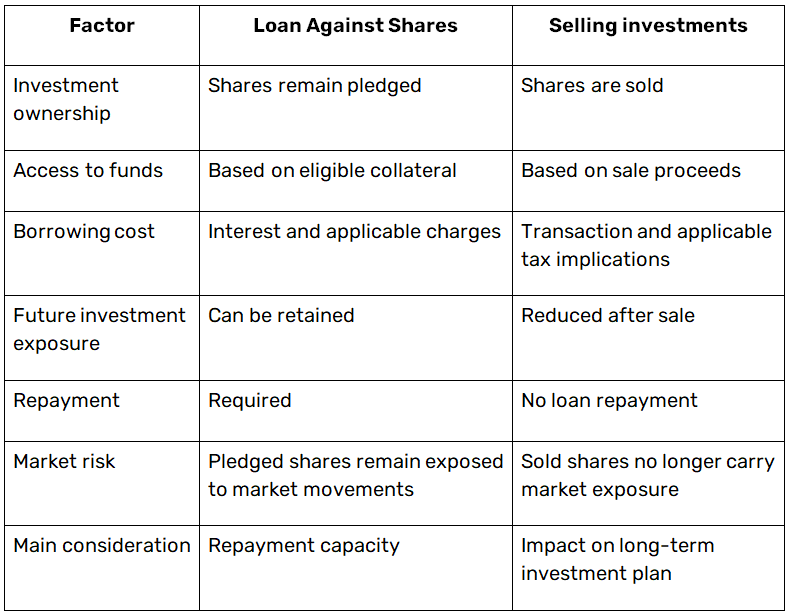
Neither option is automatically suitable for every investor. The right choice depends on the purpose, amount required, investment horizon, and repayment capacity.
When can borrowing against stocks make sense?
A loan against stocks can be considered when the financial requirement is temporary and the investor expects to repay the borrowing.
For example, an investor may hold eligible shares for a long-term objective. Selling those holdings for a short-term cash requirement could disrupt the investment strategy.
Pledging eligible shares can provide access to funds while retaining ownership.
However, investors should not pledge securities without understanding the applicable conditions. They should also avoid borrowing more than they reasonably need.
Bajaj Finance allows eligible investors to access Loan Against Shares through applicable online and offline channels. This provides flexibility when applying for the facility.
What happens if the value of pledged shares falls?
Listed shares are market-linked assets. Their value can change based on market conditions.
A fall in the value of pledged securities can affect the collateral supporting the borrowing arrangement. Depending on the applicable terms, the borrower may need to take corrective action.
This could involve providing additional eligible collateral or meeting other lender requirements.
Investors should therefore monitor their pledged securities and understand the applicable collateral conditions.
Timely repayment is equally important. Continued default can create a risk of asset liquidation.
What charges should you check before borrowing?
The interest rate is only one component of the overall borrowing cost.
Before taking a Loan Against Shares, investors should check:
Applicable interest rate
Processing fees
Documentation charges
Stamp duty
Penal charges
Foreclosure charges
Repayment schedule
Collateral requirements
Conditions for additional collateral
Bajaj Finance provides online account management facilities for applicable customers. Reviewing the loan account regularly can help borrowers track their repayment obligations.
Investors should read the applicable terms and conditions before pledging their securities.
How can an EMI Calculator help?
An EMI Calculator can help estimate monthly instalments based on the loan amount and tenure. This can help investors assess whether the proposed borrowing fits their cash flow.
For example, an investor considering a specific loan amount can compare different tenures. A longer tenure may reduce the monthly instalment but can increase the overall interest paid.
The calculator therefore provides a useful starting point for assessing affordability.
However, the actual repayment amount depends on the applicable loan terms, interest rate, and charges.
The cost is more than the immediate cash received
The decision between selling investments and borrowing against them should consider the complete financial impact.
Selling can reduce investment exposure and potentially affect long-term financial goals. Borrowing can preserve investments but creates interest and repayment obligations.
A loan against stocks can therefore be useful when retaining eligible investments is important and repayment capacity is strong.
Bajaj Finance provides loans against eligible shares after compliance with the conditions and requirements. It is advisable that investors evaluate their collateral before availing of the loan.
In the end, the choice depends on the objective of the loan, time frame, liquidity needs, and repayment abilities at hand.
Borrowing against the asset may or may not be cheaper than selling it. What matters is the liquidity factor and interest rates.
Media Info
Company Name: Bajaj Finance
Email: wecare@bajajfinserv.in
City: Pune
Country: India
Website: https://www.bajajfinserv.in/